Artificial intelligence
My vision
The next leap in biology will be a tool, and the people who need it most should be the ones building it.
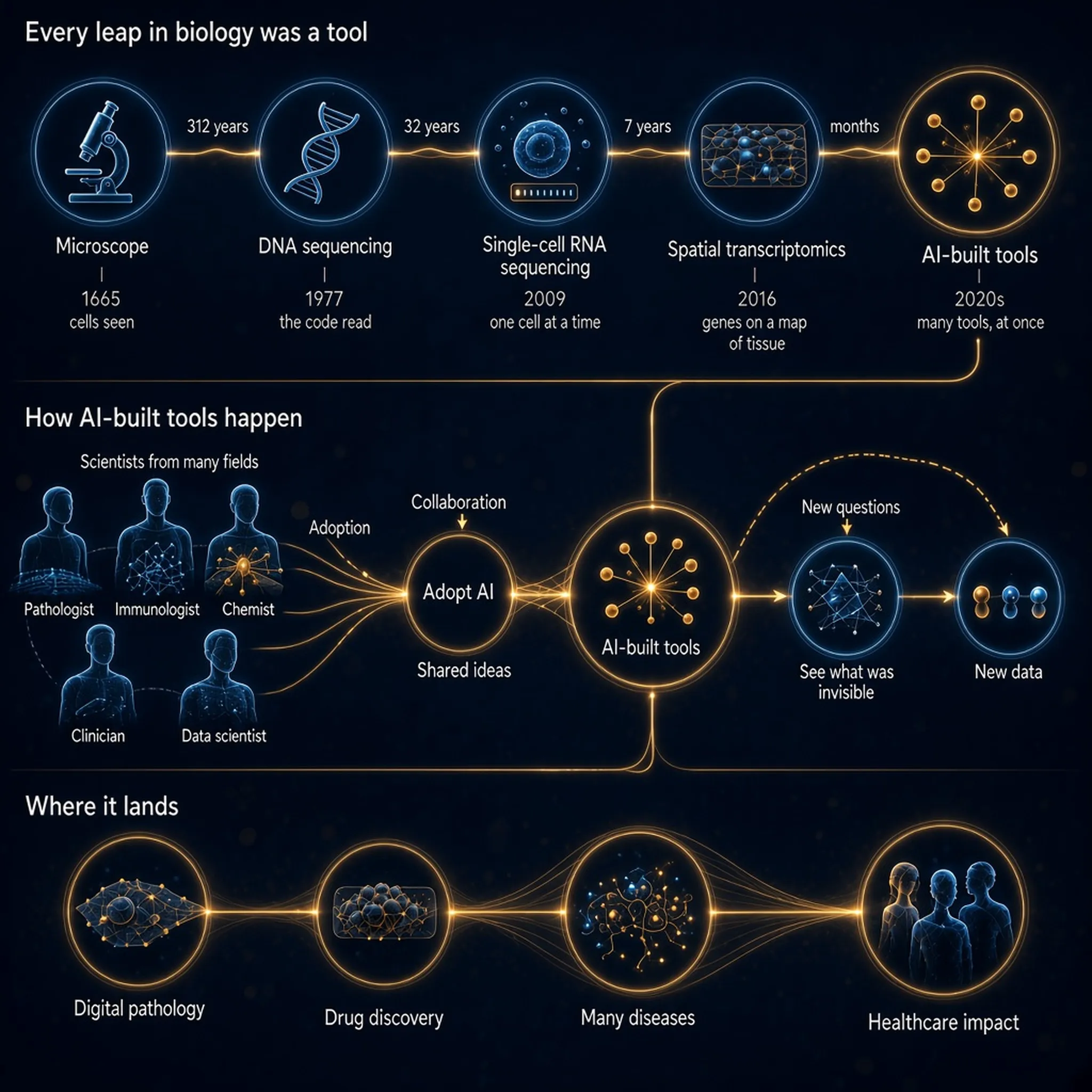
I am excited about this technology, and we have not scratched the surface. What AI will mean for science is mostly unbuilt. The tools available today are early versions of something much larger, and the people best placed to build the next ones, scientists at the bench, have barely started. That gap is the interesting part.
Right now most of the attention goes to reading the data we already have: digging into large and complicated datasets, finding the patterns inside them, building models that predict an outcome. That work is good, and I do plenty of it. A dataset that took a team years to produce can now be questioned from many angles in a week. Deeper analysis of existing data is real progress, and it should continue.
The bigger change comes when working scientists use AI to build their own tools. A tool built at the bench can see things in the data that no instrument was looking for, and can pull out measurements that were never an option before. A scientist at the bench knows which question is stuck. Give that person the ability to build, and the tool arrives shaped to the question, sometimes very niche, sometimes very big. Question to tool to new data to better question: that loop is where I think the field moves.
History supports this. Every leap in biology came from a tool. The microscope showed us cells. DNA sequencing let us read the instructions inside them. Spatial transcriptomics, which maps which genes are switched on at each spot in a slice of tissue, turned a flat image into a map of behaviour. Each was an instrument, and the understanding followed it. AI will produce a generation of instruments, most of them software.
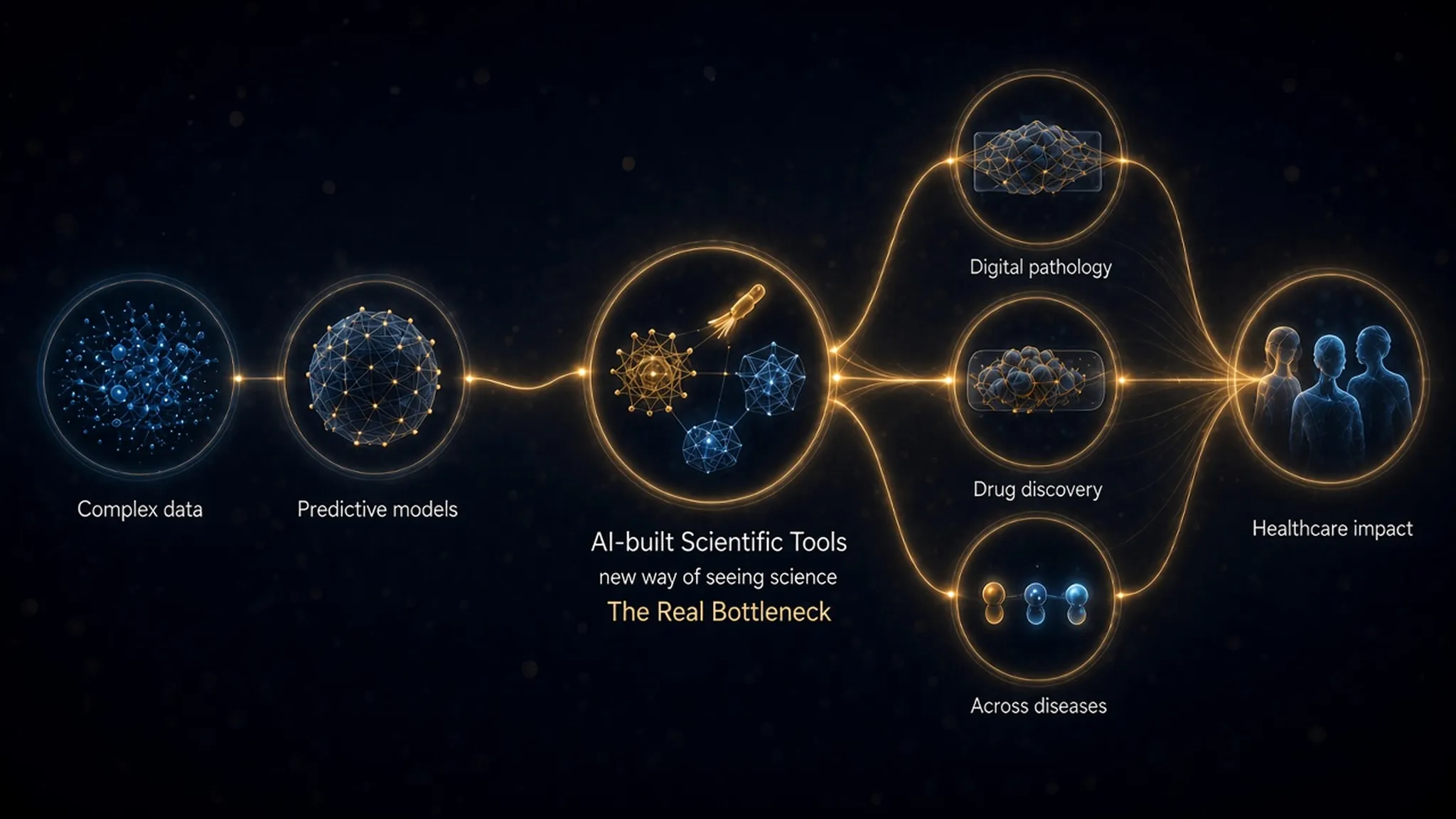
AI is already at work in life science. It reads pathology slides and ranks drug candidates, and it does this in software alone, with no new hardware. That is a good start. The bigger change is still ahead. Discovery moves at the speed of its machinery. Every field can only go as far as the instruments it knows how to build, and those instruments are bounded by what we already understand. I believe AI will push past that boundary. It will help us design instruments we could not have engineered on our own, and reach questions that have sat out of range. This is my view from life science. I do not think it stops there. Any industry held back by its hardware faces the same wall, up to and including travel through space. Wherever the tool is the bottleneck, AI will help us build a better one.
The obstacle is adoption. Scientists are busy people whose day-to-day work does not pause. A small number use AI seriously, and most of them are bioinformaticians, who understand the science deeply. The limit is structural: they answer questions using data that other people have already generated. When the scientists designing the experiment can also build the tool, the data itself changes, and so do the questions worth asking.
So my aim is practical: raise adoption among working scientists, and build partnerships that make building a tool the normal first move. Some problems have waited years, and some decades, because the work needed to attack them was too slow for any one team. Those bottlenecks set the pace of a field. The limiting factor, in my view, will be people who know a field well enough to see which bottleneck matters and know the tools well enough to remove it. I want to be one of them. I am optimistic about where this goes, and I would like to hear from anyone building toward the same thing.
AI in cancer research
AI is part of every working day for me, and it is the most consequential tool I have used. In my own work, most of the hours used to go to the tasks between the ideas: cleaning data, writing and checking analysis code, finding the three papers that matter in a hundred. AI now takes on much of that. It changes what one researcher can attempt, and it changes what I expect of the next decade.
Recognition and tools
In 2026 my application to Anthropic's AI for Science program, for a project built around AI at every step, was accepted. I work with Anthropic's current models through Claude Code and the API, in Python and R in VS Code, and I build small agents of my own for the repeated work: data curation, literature screening, and the checks I want run every time. I have also built a cross-linked knowledge base for a whole research program, and a set of specialist agents: ethics drafting, cytometry, histology, assay design, and an adversarial audit that tests a result before release. Earlier: a scholarship from the Australian Centre for AI in Medical Innovation (2025) and a top-ten place at the Protoaxiom Challenger Summit (2024).