Future vision
One signal, three answers
I am building a precision-oncology program in which one well-understood biological signal can do three jobs: it tells us who will progress, who will respond, and what to target next.
Biomarkers as the connective tissue
Across five programs I keep coming back to one idea. The biology that explains a tumour can also be read as a biomarker, a measurable signal that turns insight into a clinical decision. Biomarkers are where my work converges. Imaging the tumour microenvironment, training AI to interpret it, contributing to drug-discovery programs, and testing the result in the clinic all point at the same goal: signals rigorous enough to trust and accessible enough to reach every pathology lab. My work on inflammatory cytokine signalling is an early, still directional, proof of the approach.
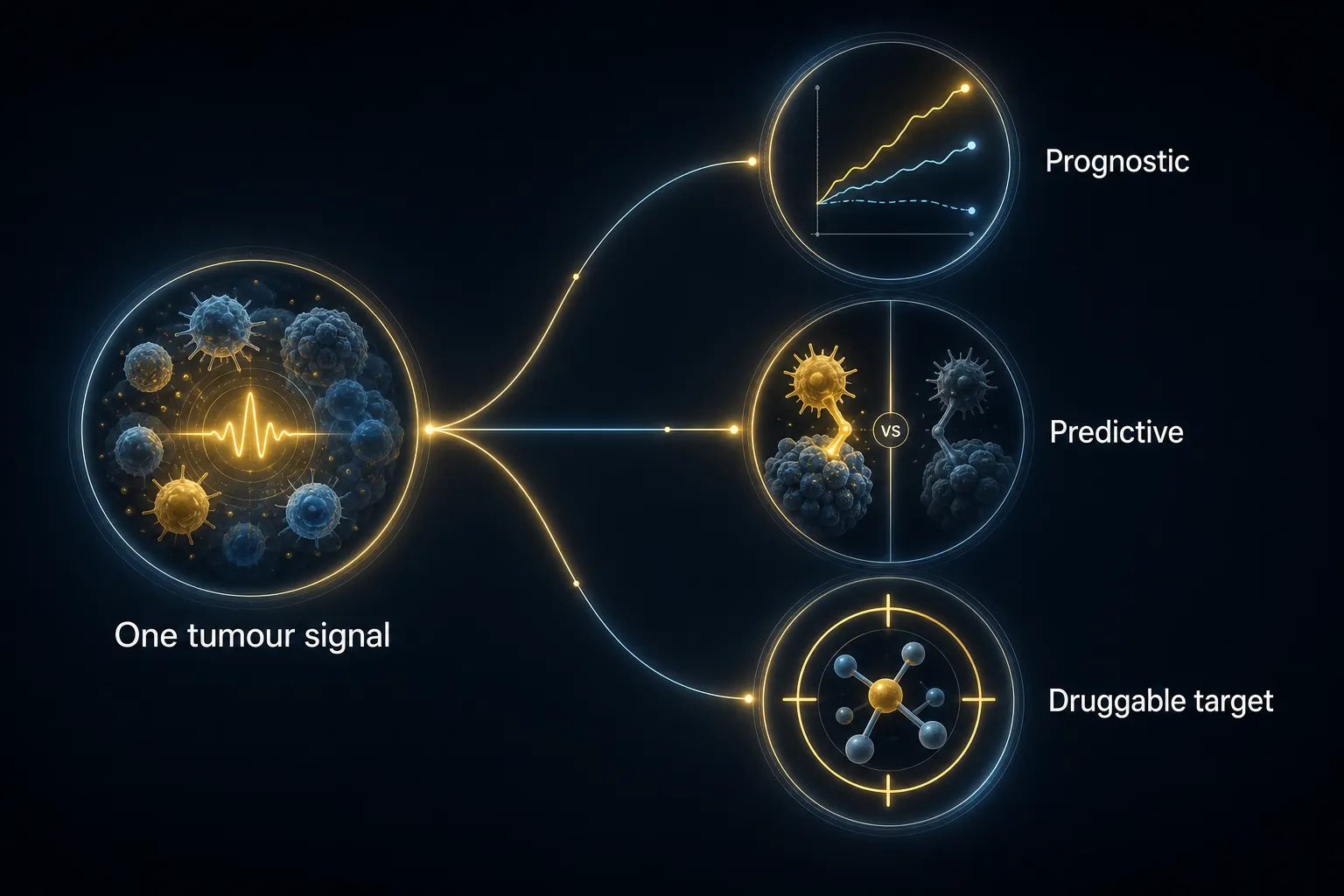
Three jobs for one signal
-
Prognostic
Reading a tumour's biology to estimate how the disease is likely to behave, so care can be matched to risk.
-
Predictive
Working out which patients a given therapy is most likely to help before treatment begins, so the right people get the right drug sooner.
-
Target-identifying
Sometimes a signal points past patient selection to the biology worth acting on next. Every such claim stays tied to the cohort it came from, so a prognostic finding is never presented as a predictive one.
From mechanism to bedside
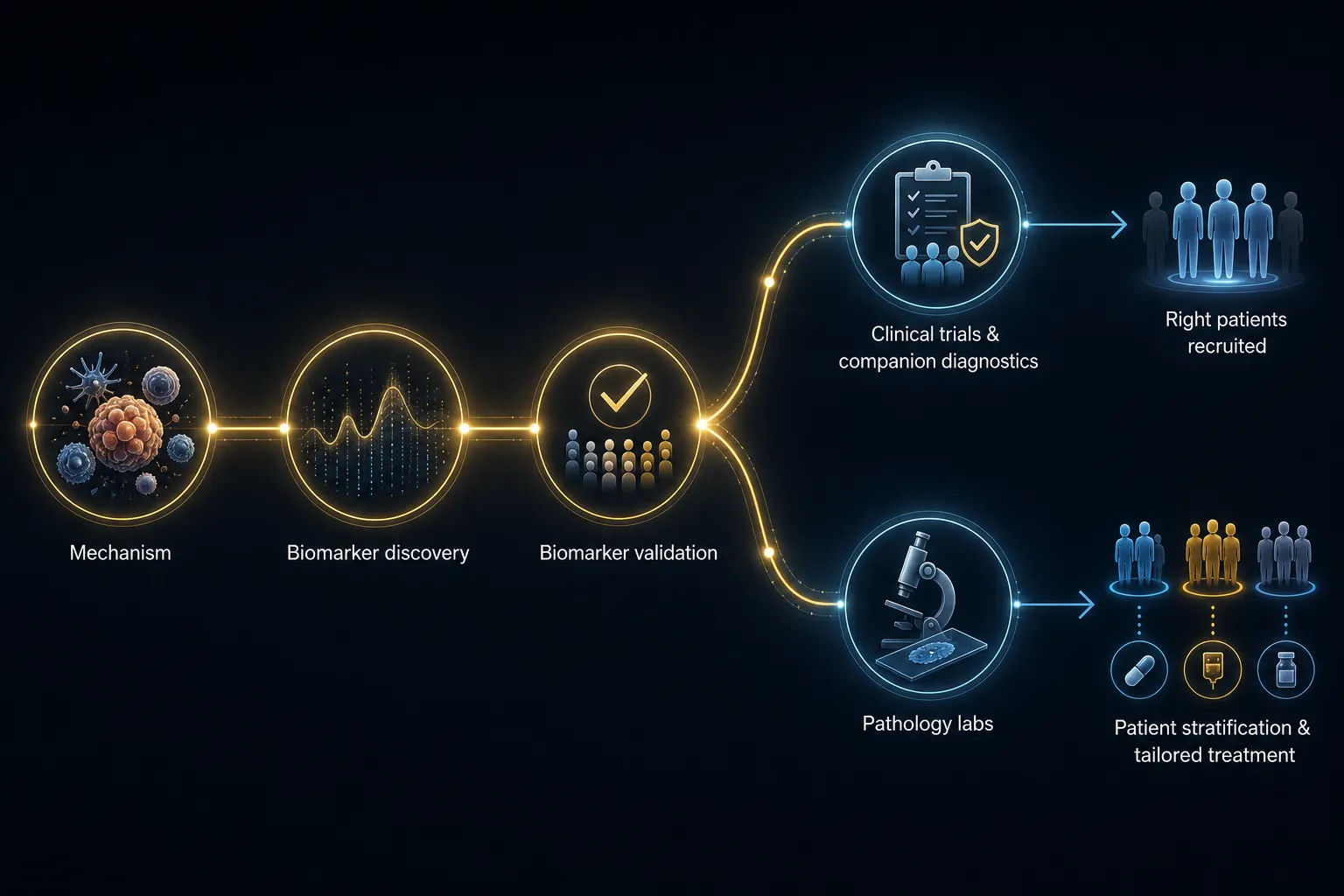
Each program is one link in the same chain. Tumour immunology supplies the mechanism. Spatial imaging makes the signal visible in standard tissue. AI turns that image into a readout a pathologist can interpret. The clinical study tests whether the readout tracks real patient outcomes. Followed from start to finish, the path runs from mechanism to biomarker to a clinic-ready assay to a companion diagnostic, and back into the study that validates it. I build and run the analysis side of that loop myself. That is what lets one discovery become a test, a target, and a treatment decision.
AI runs through much of this. How I use it day to day, and where I think it goes, has its own page: AI in cancer research.
Collaborate · Connect
Build this with me
If you work in tumour immunology, spatial biology, or AI for diagnostics, I would like to hear from you about where this program goes next.